



Pe parcursul proiectului SUBMARIN au fost testate diferite coduri numerice şi tehnici de calcul avansat cu scopul alegerii metodelor ideale de analiză pentru modelarea proceselor legate de subducţia neregularităţilor batimetrice ale plăcilor oceanice (munţi submarini şi zone de fractură) şi impactul asupra marginilor de placă active. Rezultatele au fost prezentate in cadrul conferinţei internaţionale EGU General Assembly, în perioada 23–28 Aprilie, 2023. .
• 1) Manea, V. C., Manea, M., and Petrescu, L.: Subduction of bathymetric irregularities along active margins: insights from numerical modeling, EGU General Assembly 2023, Vienna, Austria, 23–28 Apr 2023, EGU23-5078, https://doi.org/10.5194/egusphere-egu23-5078, 2023. Abstract Oceanic plates are far from homogeneous, and a large number of bathymetric discontinuities such as seamounts of different sizes are transported along by plate motion towards the mid ocean trenches and beyond. Seamounts currently colliding with plate margins show a major role in shaping the forearc morphology, and several studies even suggest that they might be related with seismicity. However, it is not clear what happens after seamounts are subducted, they can be accreted to the forearc, carried down into the subduction zone and recycled into the deep mantle, or a mix of the two scenarios. Using high-resolution two-dimensional thermomechanical numerical simulations, we investigate subduction processes of oceanic plates with a heterogeneous structure marked by a series of basaltic seamounts arranged in a chain like structure. We solve the 2D momentum, continuity and energy equations with the finite differences coupled with PIC (particle-in-cell) method. Our models also incorporate a depth-dependent, realistic non-Newtonian visco-elasto-plastic rheology, and plasticity is implemented using a yield criterion which limits the creep viscosity. Preliminary results show that initially seamounts preserve they structure when impacting with the trench. Their integrity is partially conserved until they subduct to a depth of about 25-30 km when they finally start to succumb to the great deformations and stresses along the slab interface. We observed that the lower part of the seamount continuously deforms and amalgamates along the slab interface. The upper part is detached and incorporated into the forearc structure. The subsequent seamounts that trail the first seamount, follow the same deformation pattern, and the top of them are maintained in the highly deformed forearc region. Our preliminary modeling results confirm that seamount subduction represent a key tectonic process that influences on a long-term time scale the structure and evolution of subduction zones.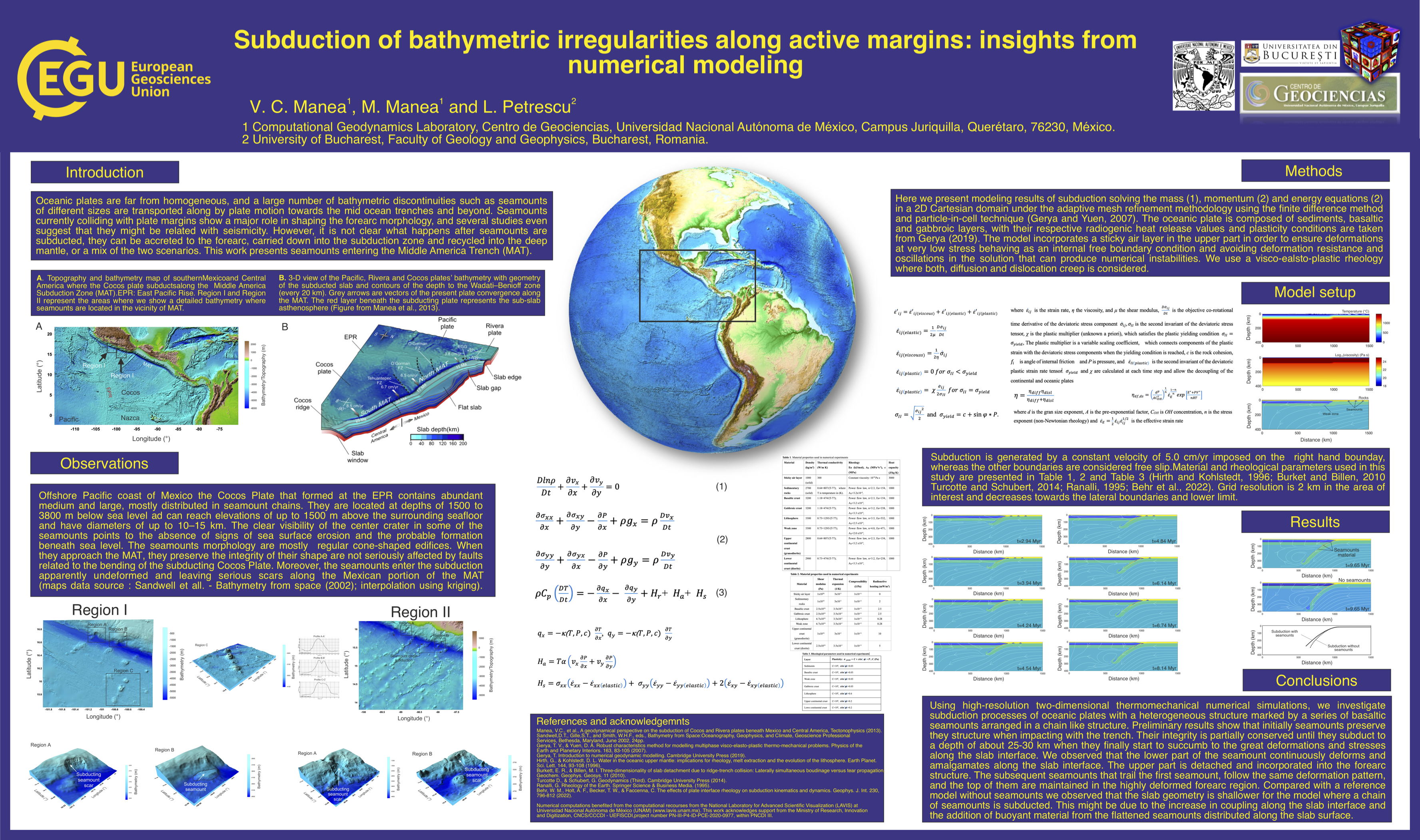 • 2) Manea, M., Sewell, G., Manea, V., and Petrescu, L.: Hydrothermal circulation in oceanic crust along Middle America Trench: insights from numerical modeling, EGU General Assembly 2023, Vienna, Austria, 23–28 Apr 2023, EGU23-4999, https://doi.org/10.5194/egusphere-egu23-4999, 2023.
Abstract
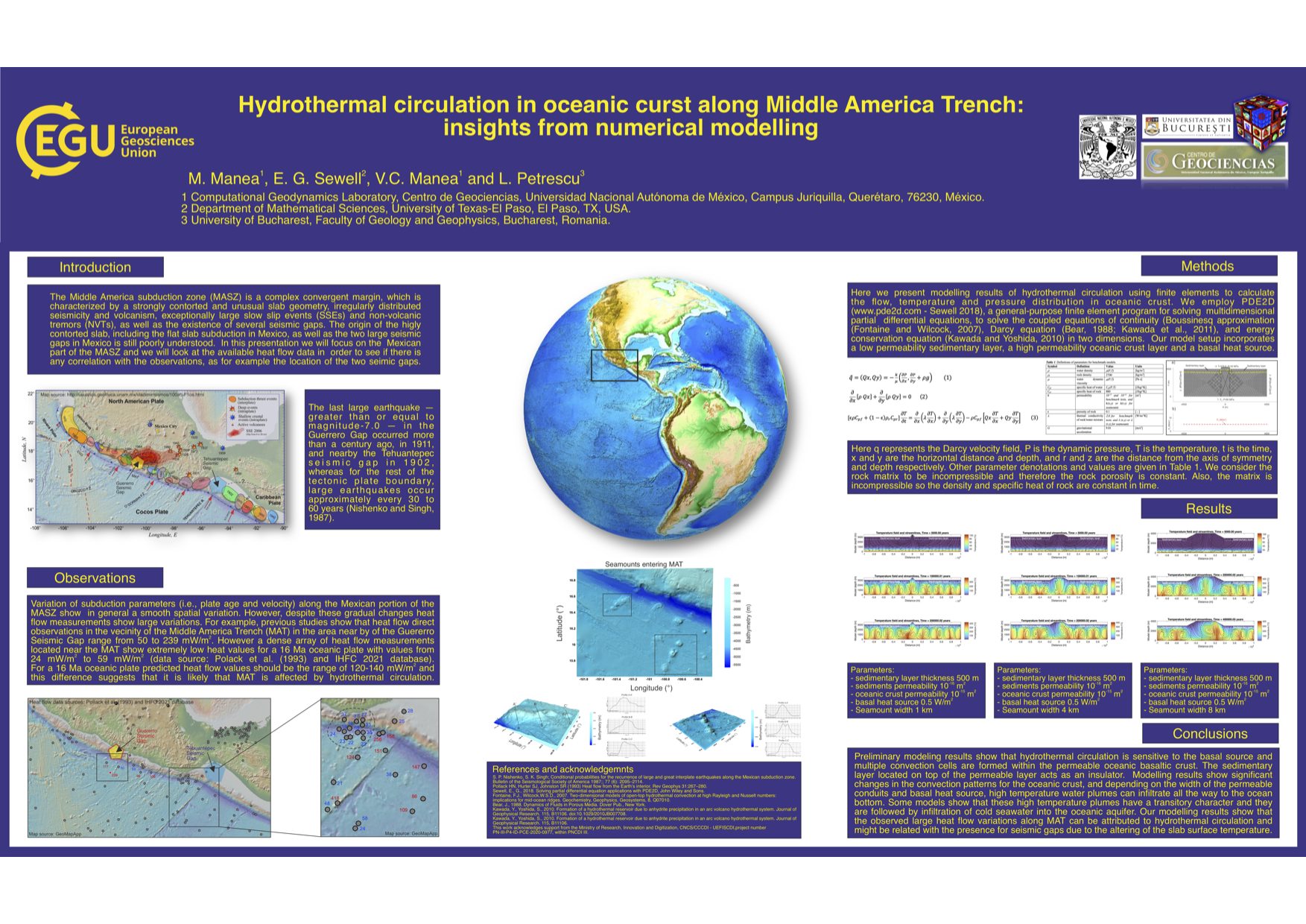
Variation of subduction parameters (i.e., plate age and velocity) along trenches show in general a smooth spatial variation. However, despite these gradual changes heat flow measurements show large variations. For example, previous studies show that heat flow direct observations along the Middle America Trench (MAT) range from 14 to 261 mW/m2, without a clear pattern. One of the common hypotheses that can explain such variations is the presence of hydrothermal circulation within the oceanic crust that enters subduction. Here we present modeling results of hydrothermal circulation using finite elements to calculate the flow, temperature and pressure distribution in oceanic crust. We employ PDE2D (www.pde2d.com), a general-purpose finite element program for solving multidimensional partial differential equations, to solve the coupled equations of continuity, Darcy equation, and energy conservation equation in two dimensions. Our model setup incorporates a low permeability sedimentary layer, a high permeability oceanic crust layer and a basal heat source. Modeling results show that hydrothermal circulation is sensitive to the basal source and multiple convection cells are formed within the permeable oceanic basaltic crust. The sedimentary layer located on top of the permeable layer acts as an insulator. Therefore, smooth temperature fluctuations are observed at the surface. We adapted this model setup and incorporate a series of permeable paths in the sedimentary layer that connect the oceanic crust with the ocean bottom. Modeling results show significant changes in the convection patterns for the oceanic crust, and depending on the width of the permeable conduits and basal heat source, high temperature water plume can infiltrate all the way to the ocean bottom. Some models show that these high temperature plumes have a transitory character and they are followed by infiltration of cold seawater into the oceanic aquifer. Our modeling results show that the observed large heat flow variations along oceanic trenches can be attributed to hydrothermal circulation only when permeable pathways connect the permeable upper crust with the ocean.
• 2) Manea, M., Sewell, G., Manea, V., and Petrescu, L.: Hydrothermal circulation in oceanic crust along Middle America Trench: insights from numerical modeling, EGU General Assembly 2023, Vienna, Austria, 23–28 Apr 2023, EGU23-4999, https://doi.org/10.5194/egusphere-egu23-4999, 2023.
Abstract
Variation of subduction parameters (i.e., plate age and velocity) along trenches show in general a smooth spatial variation. However, despite these gradual changes heat flow measurements show large variations. For example, previous studies show that heat flow direct observations along the Middle America Trench (MAT) range from 14 to 261 mW/m2, without a clear pattern. One of the common hypotheses that can explain such variations is the presence of hydrothermal circulation within the oceanic crust that enters subduction. Here we present modeling results of hydrothermal circulation using finite elements to calculate the flow, temperature and pressure distribution in oceanic crust. We employ PDE2D (www.pde2d.com), a general-purpose finite element program for solving multidimensional partial differential equations, to solve the coupled equations of continuity, Darcy equation, and energy conservation equation in two dimensions. Our model setup incorporates a low permeability sedimentary layer, a high permeability oceanic crust layer and a basal heat source. Modeling results show that hydrothermal circulation is sensitive to the basal source and multiple convection cells are formed within the permeable oceanic basaltic crust. The sedimentary layer located on top of the permeable layer acts as an insulator. Therefore, smooth temperature fluctuations are observed at the surface. We adapted this model setup and incorporate a series of permeable paths in the sedimentary layer that connect the oceanic crust with the ocean bottom. Modeling results show significant changes in the convection patterns for the oceanic crust, and depending on the width of the permeable conduits and basal heat source, high temperature water plume can infiltrate all the way to the ocean bottom. Some models show that these high temperature plumes have a transitory character and they are followed by infiltration of cold seawater into the oceanic aquifer. Our modeling results show that the observed large heat flow variations along oceanic trenches can be attributed to hydrothermal circulation only when permeable pathways connect the permeable upper crust with the ocean.
 ACASĂ
ACASĂ CONCEPT
 CINE SUNTEM
 PROIECT
 BIBLIOGRAFIE
 MODELE INTERACTIVE
 PHOTOS
 APLICAŢII
 CONTACT