REZULTATE ..::.. PUBLICAŢII
Pe parcursul proiectului SUBMARIN au fost testate diferite coduri numerice şi tehnici de calcul avansat cu scopul alegerii metodelor ideale de analiză pentru modelarea proceselor legate de subducţia neregularităţilor batimetrice ale plăcilor oceanice (munţi submarini şi zone de fractură) şi impactul asupra marginilor de placă active. Rezultatele au fost publicate în revistele: Scientific Reports, Computers and Geosciences, Geophysical Research Letters. În prezent, o parte din rezultate sunt de asemenea pregătite pentru submisie în revista Tectonophysics.
•
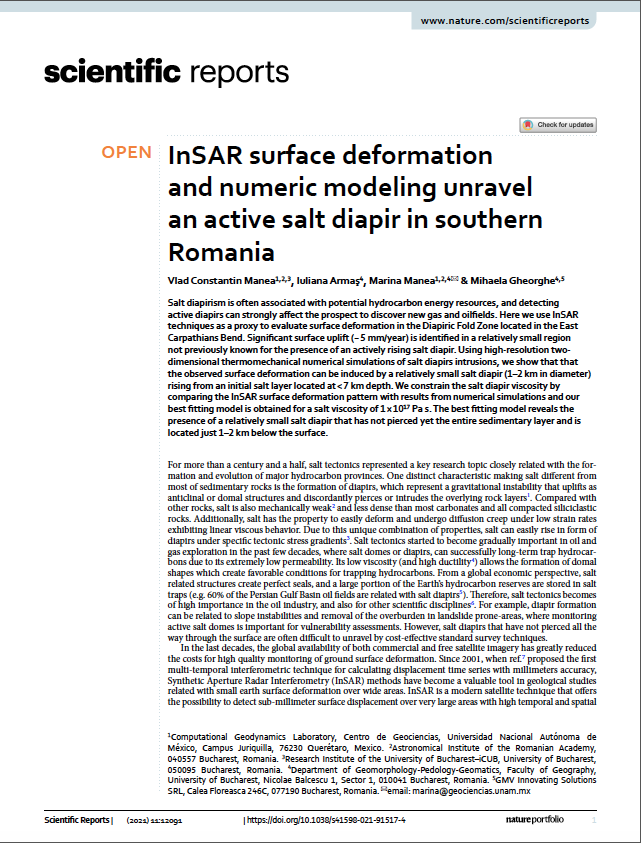
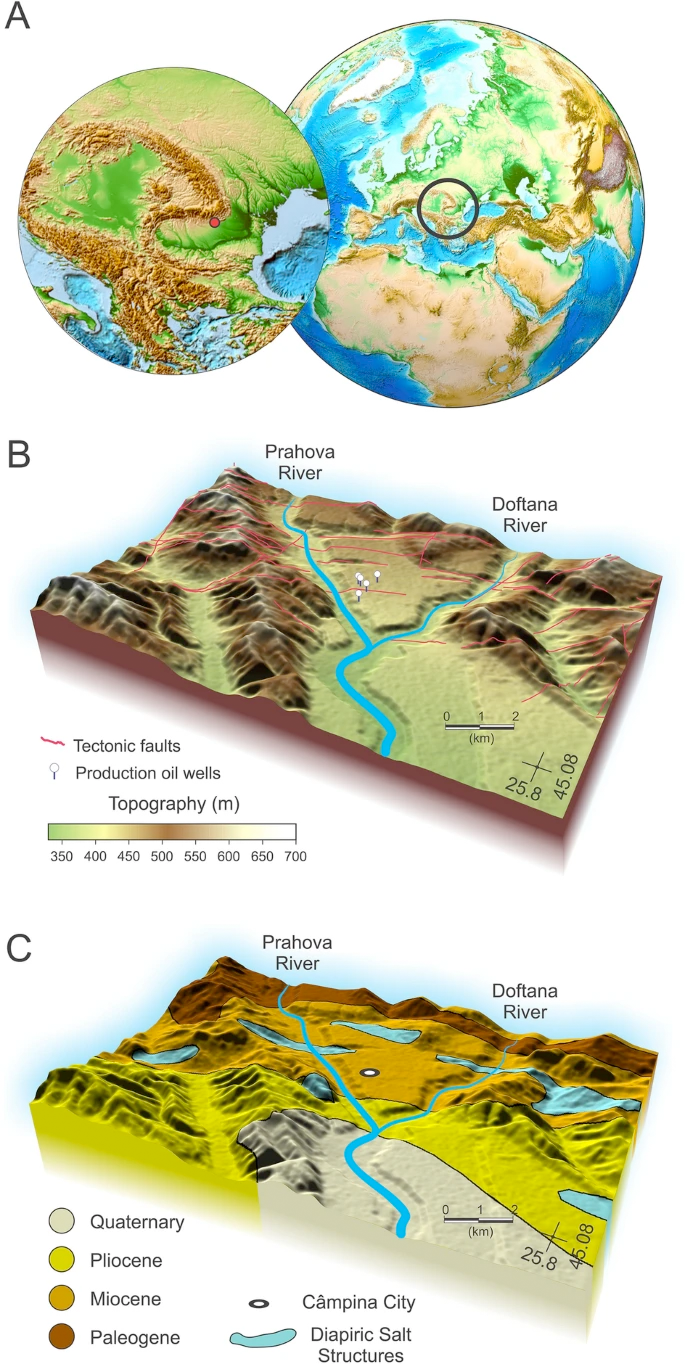
1) Vlad Constantin Manea, Iuliana Armaş, Marina Manea & Mihaela Gheorghe, 2021. InSAR surface deformation and numeric modeling unravel an active salt diapir in southern Romania. Scientific Reports volume 11, Article number: 12091 https://doi.org/10.1038/s41598-021-91517-4.
https://www.nature.com/articles/s41598-021-91517-4
 |
Abstract
Salt diapirism is often associated with potential hydrocarbon energy resources, and detecting active diapirs can strongly affect the prospect to discover new gas and oilfields. Here we use InSAR techniques as a proxy to evaluate surface deformation in the Diapiric Fold Zone located in the East Carpathians Bend. Significant surface uplift (~ 5 mm/year) is identified in a relatively small region not previously known for the presence of an actively rising salt diapir. Using high-resolution two-dimensional thermomechanical numerical simulations of salt diapirs intrusions, we show that that the observed surface deformation can be induced by a relatively small salt diapir (1-2 km in diameter) rising from an initial salt layer located at < 7 km depth. We constrain the salt diapir viscosity by comparing the InSAR surface deformation pattern with results from numerical simulations and our best fitting model is obtained for a salt viscosity of 1 × 10¹⁷ Pa s. The best fitting model reveals the presence of a relatively small salt diapir that has not pierced yet the entire sedimentary layer and is located just 1–2 km below the surface.
|
|
•
2) E.G. Sewell & V.C. Manea, 2021. Solving the Laplace Tidal Equations using Freely Available, Easily Extensible Finite Element Software. . Computers & Geosciences Volume 155, 104865.
https://doi.org/10.1016/j.cageo.2021.104865
 |
Abstract
The Laplace Tidal Equations (LTEs) play a basic role for investigating the dissipation of long-term orbital energy as heat in surface oceans of icy satellites. Here we address solving LTEs by means of finite elements using PDE2D, a general-purpose finite element program for solving multidimensional PDEs. We use PDE2D to solve the equations for eccentricity and obliquity gravitational potentials for a shallow water approximation, and calculate ocean dissipation in three icy satellites, Enceladus, Europa and Titan. Compared with previous modeling procedures, PDE2D solves for unknowns that are approximated by piecewise cubic polynomials, thus attaining a higher O(dφ4) + O(dθ4) numerical precision. Our modeling results show, within few percent errors, a good agreement with earlier semi-analytical models and numerical solutions. We provide an open access to our PDE2D codes which are intended to be simple and easy to adjust for a wide range of tidal heating related problems. Our modeling results show that PDE2D can be a useful tool for researchers studying tidal heating related problems.
|
|
•
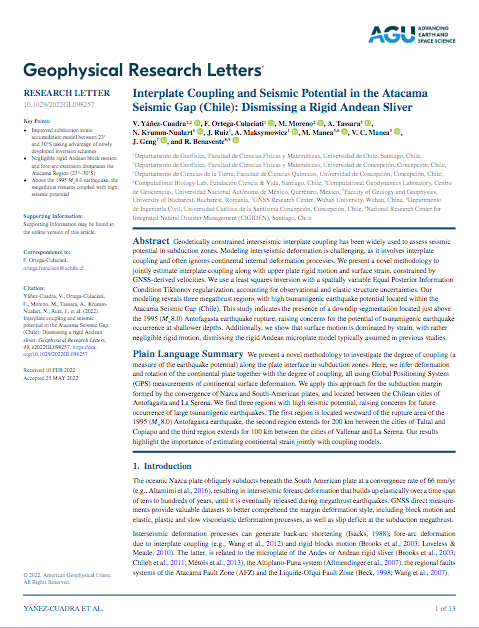
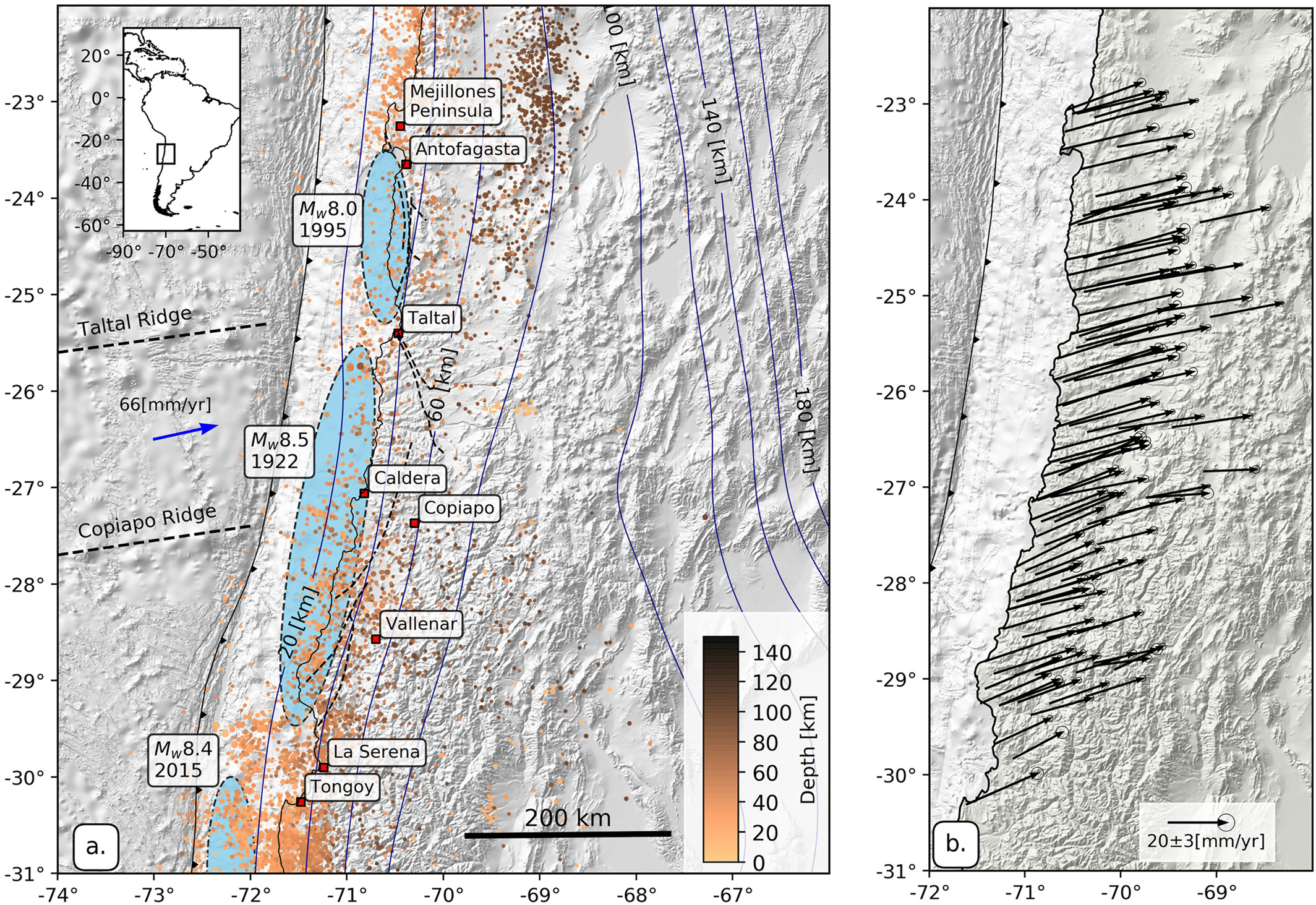
3) V. Yáñez-Cuadra, F. Ortega-Culaciati, M. Moreno, A. Tassara, N. Krumm-Nualart, J. Ruiz, A. Maksymowicz, M. Manea, V. C. Manea, J. Geng, and R. Benavente, 2022. Interplate Coupling and Seismic Potential in the Atacama Seismic Gap (Chile): Dismissing a Rigid Andean Sliver. Geophysical Research Letters, Volume49, Issue 11, e2022GL098257.
https://agupubs.onlinelibrary.wiley.com/doi/abs/10.1029/2022GL098257
 |
Abstract
Geodetically constrained interseismic interplate coupling has been widely used to assess seismic potential in subduction zones. Modeling interseismic deformation is challenging, as it involves interplate coupling and often ignores continental internal deformation processes. We present a novel methodology to jointly estimate interplate coupling along with upper plate rigid motion and surface strain, constrained by GNSS-derived velocities. We use a least squares inversion with a spatially variable Equal Posterior Information Condition Tikhonov regularization, accounting for observational and elastic structure uncertainties. Our modeling reveals three megathrust regions with high tsunamigenic earthquake potential located within the Atacama Seismic Gap (Chile). This study indicates the presence of a downdip segmentation located just above the 1995 (Mw8.0) Antofagasta earthquake rupture, raising concerns for the potential of tsunamigenic earthquake occurrence at shallower depths. Additionally, we show that surface motion is dominated by strain, with rather negligible rigid motion, dismissing the rigid Andean microplate model typically assumed in previous studies.
|
|
 În pregătire:
M. Manea, V.C. Manea and L. Petrescu, 2023. "Hydrothermal circulation for Cocos plate seamounts: insights from numerical modeling." In pregatire pentru submisie in Tectonophysics.




 ACASĂ
ACASĂ CONCEPT
 CINE SUNTEM
 PROIECT
 BIBLIOGRAFIE
 MODELE INTERACTIVE
 PHOTOS
 APLICAŢII
 CONTACT